A Complete Guide to AI Search Optimization: GEO, AIO, and AEO explained in one article
In Q1 of 2026, the marketing director of a cross-border e-commerce brand conducted a test: using the same product-related questions to search on Google, ChatGPT, Perplexity and Gemini, he found that the brand ranked third on the Google homepage, but was not mentioned once on the four AI search platforms. No matter how good traditional SEO is, it may be completely "invisible" in the era of AI search.
This is why AI search optimization has become the hottest topic in global expansion marketing in 2026. But the question is: There are so many terms on the market about AI search - GEO, AIO, AEO, LLMO. Which one is the correct term? What's the difference between them? How should companies choose?
This article makes it clear once and for all. You will understand the three mainstream frameworks of AI search optimization, their respective applicable scenarios, and how to develop the correct optimization strategy based on your business goals.
Three major frameworks for AI search optimization: GEO, AIO, AEO
First clarify the concept. Optimization for AI search is not a single technology, but an umbrella concept. Currently, there are three main frameworks in the industry:
| frame | full name | core goals | Main platform |
|---|---|---|---|
| GEO | Generative Engine Optimization | Let brands become recommendations in AI-generated answers | ChatGPT, Gemini, Perplexity, Claude |
| AIO | AI Overview Optimization (AI Overview Optimization) | Get your brand featured in Google AI Overview summaries | Google Search (AI Overview/SGE) |
| AEO | Answer Engine Optimization | Make content the preferred citation source for AI searches | All AI Search + Voice Search + Featured Snippets |
The three are not substitutes for each other, but approach the big proposition of "making brands found in AI searches" from different angles. According toSearch Engine Journal analysis, these three frameworks are rapidly integrating, and ultimately they all point to the same goal:Let brands be the answer to AI.
Want to know how your brand performs in AI search? Request a Free AI Search Visibility Diagnosis →
GEO (Generative Engine Optimization): the core of AI search optimization

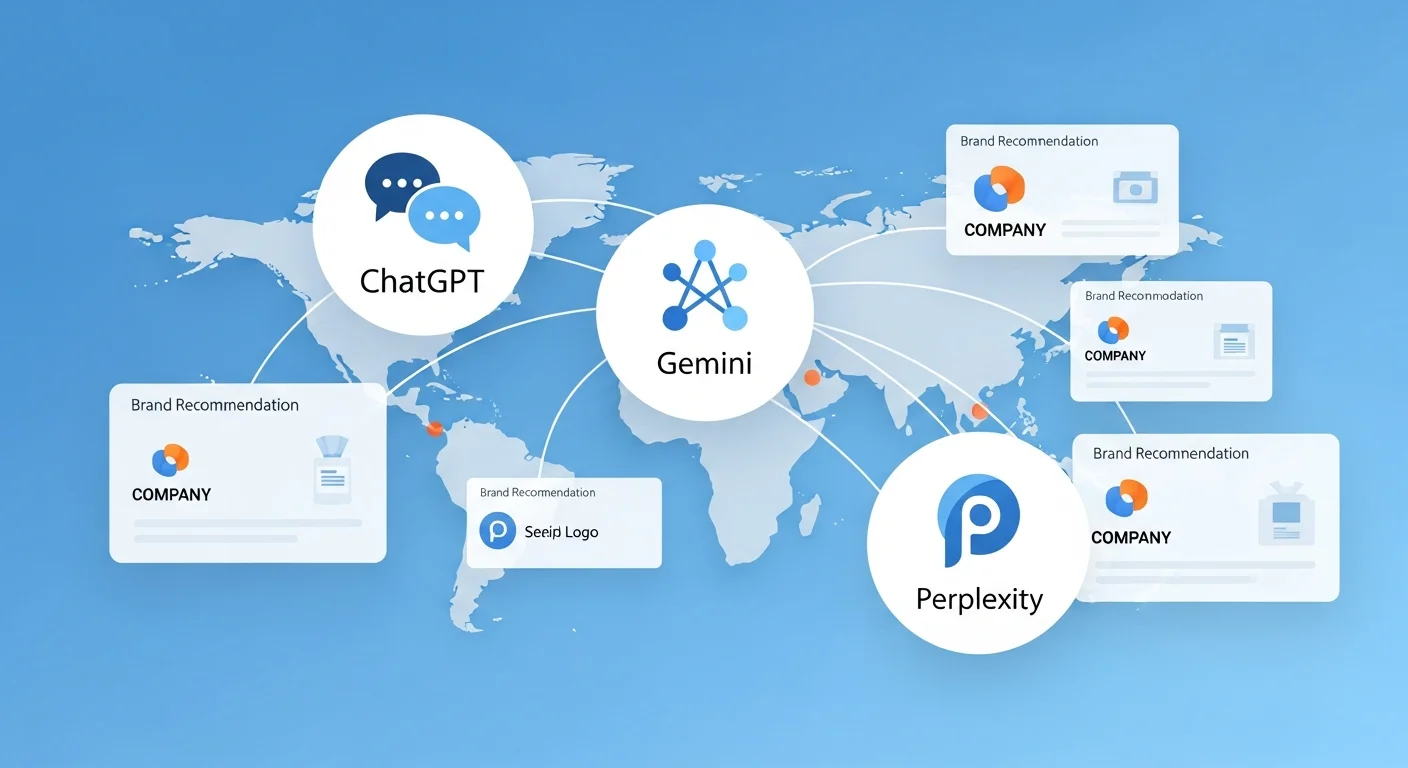
GEO is the one with the widest coverage and the most attention among the three frameworks. When a user asks a question in ChatGPT, Gemini or Perplexity, the AI model will filter the content from massive information to generate an answer - GEO's goal is to make your brand a priority reference and recommendation object by AI.
What is the difference between GEO and traditional SEO?
The goal of traditional SEO is "ranking" - the higher the position on the Google search results page, the better.The goal of GEO is to "cite" - Let AI proactively recommend your brand.
| Dimensions | Traditional SEO | GEO |
|---|---|---|
| core indicators | Keyword ranking, natural traffic | Share of Model, AI citation rate |
| Content requirements | Keyword matching, page optimization | Authoritative, structured, citable |
| External link value | Improve domain name authority | Enhance brand knowledge anchors |
| Optimization object | Google crawler | AI Large Model (LLM) |
| Effective way | Ranking improvement→clicks→traffic | AI citation → brand recommendation → trust building |
GEO's core methodology
GEO optimization consists of 5 key links, which SeaSeek summarized in practice as "GEO optimization five-step method":
- Brand knowledge anchor point construction: Let the AI model "recognize" your brand - establish a structured brand information system, includingSchema. orgBrand information from authoritative platforms such as structured data, knowledge graphs, and Wikipedia
- AI-friendly content creation: Not an ordinary SEO article, but content that is easy for the AI model to understand and quote - clear definitions, data support, expert opinions, and a structured question and answer format.
- Brand mention expansion: Increase the frequency and quality of brand mentions in industry media, authoritative platforms, and academic papers
- Differentiated coverage of multiple engines: ChatGPT, Gemini, and Perplexity each have different citation preferences and require differentiated strategies.
- Effect tracking and iteration: Quantify the effect through indicators such as Share of Model and brand mention rate
At the beginning of 2025, after six months of implementing GEO optimization for a SaaSglobal expansion client, the frequency of brand recommendations in ChatGPT increased from 0 to the top 3% in the industry, and the average monthly inquiries brought by AI search channels increased from 0 to 20+.
AIO (AI Overview Optimization): Special strategy for Google AI search
AIO focuses on the AI Overview (formerly SGE) function in Google search. When a user searches on Google, AI will generate an AI snippet above the traditional search results - the goal of AIO is to make your content appear in this snippet.
The particularity of AIO
The biggest difference between AIO and GEO is that AIO optimizes Google's own AI search function, while GEO covers independent AI search platforms such as ChatGPT and Perplexity.
The core logic of AIO: The reference content of Google AI Overview mainly comes from web pages that have been indexed by Google. This means that doing traditional SEO well is the foundation of AIO - if your content ranks poorly in Google, the probability of appearing in AI Overview is also very low.
According toGoogle official documentationDescription, AI Overview will give priority to citing: - Clear structure and clearly defined content - Pages with data and specific cases - Content sources with strong E-E-A-T signals - Pages that already rank high in relevant searches
AIO practical points
- Do basic SEO skills first: Technical SEO, content quality, and external link construction are still the foundation.
- Optimize Featured Snippet: The citation logic of AI Overview and featured snippets highly overlaps.
- Structured Q& A content: Ask the question in H2, followed by a concise answer of 40-60 words
- Provide unique data and perspectives: AI Overview tends to cite content with unique value
AEO (Answer Engine Optimization): for all "give answer" searches

The concept of AEO appeared earlier than GEO and AIO, and was originally optimized for voice search (Alexa, Siri) and Google featured snippets. With the rise of AI search, the scope of AEO has expanded to all "direct answer" search forms.
The core idea of AEO
The core of AEO is:Turn your content into the best answer. Whether users are searching on Google, asking questions on ChatGPT, or using Siri voice queries, your content should be the preferred citation source for AI.
AEO optimization methodology emphasizes three levels:
content layer: - Each page answers a core question - Answers must be concise, accurate and authoritative - Mark frequently asked questions with FAQ Schema - Provide "golden sentences" passages that can be directly quoted
Technical layer: - structured dataMarkup (FAQ, HowTo, Article Schema) - Page loading speed optimization - Mobile friendly - Clear page hierarchy
authority level: - Author information and expert background - Citations and endorsements from third-party authorities - Industry data support - Continuous content updates
How to choose between GEO, AIO and AEO: a decision matrix
Which framework should an enterprise choose for AIO optimization or GEO optimization? The answer depends on your business goals and resources:
| decision factors | Choose GEO | Choose AIO | Choose AEO |
|---|---|---|---|
| main goal | Build brand visibility on AI search platforms | Get exposure in Google AI Overview | Be the go-to answer source for all searches |
| Suitable for industry | B2B, SaaS, professional services | E-commerce, local services, information content | Knowledge-intensive, tool-based products |
| Preconditions | Have brand content foundation | Good SEO foundation and ranking | High quality content and expert resources |
| Effective cycle | 3-6 months | 1-3 months (based on existing SEO) | 2-4 months |
| investment level | Medium-High | Low-Medium (SEO extension) | in |
Our advice: Don't regard the three as either-or choices. For most global expansion brands, the most effective strategy isMainly GEO optimization, supplemented by AIO and AEO. GEO solves the core problem of "brand visibility on the AI search platform", and AIO and AEO are supplements in specific scenarios.
Not sure which framework is best for you? Book a free AI search optimization strategy consultation →
A practical roadmap for AI search optimization

No matter which framework you choose, you can move forward according to the following roadmap:
Step One: AI Search Visibility Audit (Weeks 1-2)
Search your core keywords and brand name in ChatGPT, Gemini, Perplexity, and Google AI Overview, and record: - Number of times the brand is mentioned - How often competing products are recommended - Sources of content cited in AI answers
Step 2: Develop an optimization strategy (Weeks 2-3)
Prioritize based on audit results - which platforms are most important, which keywords are most valuable,What GEO assets need to be prepared?.
Step Three: Content Construction and Optimization (Months 1-4)
Promote three directions at the same time: - Brand knowledge anchor: Structured data, knowledge graph, authoritative platform information - AI-friendly content: Create new or modify existing content - Brand mentions: Industry media, partners, third-party platforms
Step 4: Monitor and iterate (continuous)
SeaSeek uses a self-developed AI keyword ranking optimization system (registration number: 2025SR2036972) to track the brand's performance on various AI search platforms and regularly adjust strategies. Key indicators includeShare of Model, brand mention rate and AI citation frequency.
At the end of 2024, Gartner predicted that search engine traffic would decline by 25% by 2026. This prediction is becoming reality. According toGartner research report, more and more users are beginning to use AI search instead of traditional search to obtain information.
As an official certified partner of Google (ID: 4908182032), SeaSeek is one of the earliest systematicGEO optimization servicesThe team integrates the three frameworks of GEO, AIO and AEO into a unified methodology. If your brand is considering deploying AI search, the most efficient way is to start with a professional AI search visibility audit.
Learn more about GEO: Download the "GEO Optimization White Paper"
If you want to systematically master the GEO methodology, especially GEO, the core AI search optimization framework, it is recommended to read the industry's first Chinese and English publication by SeaSeek"GEO Optimization White Paper".

Core content of the white paper:
- Complete solution to GEO technology framework: A complete technical path from brand knowledge anchor to AI citation rate optimization, helping you understand the underlying logic of GEO optimization
- The relationship between GEO, AIO and AEO: Integration strategies and differentiated execution plans of the three major frameworks
- Multi-platform optimization practice: Differentiated optimization methods for AI search platforms such as ChatGPT, Gemini, Perplexity, and Claude
- Effect measurement system: Definition and tracking methods of core indicators such as Share of Model and AI citation rate
- Enterprise implementation roadmap: A phased implementation guide from auditing to construction to monitoring
This white paper condenses SeaSeek's core methodology in the GEO field and is compiled based on practical experience in serving 500+ global expansion companies and technical accumulation of 7 software copyrights.
Contact us to get the full version of "GEO Optimization White Paper" →
FAQ
Is it necessary to understand the three concepts of GEO, AIO and AEO?
It is necessary to understand the difference but not to perform them separately. The three have 80% overlap at the practical level - high-quality content, structured data, and brand authority building are effective for all three frameworks. It is recommended to use GEO as the main line, which naturally covers the optimization requirements of AIO and AEO.
Will AI search optimization replace traditional SEO?
It won't replace it, but it will profoundly change it. Traditional SEO is still the core means of obtaining natural traffic, but AI search is taking away an increasing share of traffic. The optimal strategy isSEO+GEO dual-track parallel, allowing brands to remain visible in both traditional and AI searches.
How much budget is needed for AI search optimization?
Depends on industry competition and the existing foundation of the brand. The monthly fee for basic AEO optimization starts from 5, 000 yuan, and the systematic GEO optimization is 15, 000-40, 000 yuan per month. For details, please refer to our previousGEO optimization cost analysis.
Is it necessary for small businesses to do GEO optimization?
It is necessary, and it is the most cost-effective to do now. Competition in the AI search field is not yet fierce, and brand building costs are relatively low. Small businesses can start with an AI search visibility audit to understand the current status of the brand in AI search, and then optimize accordingly.
Which AI search platform is the most important and which one should be optimized first?
If your target market is overseas (especially Europe and the United States), prioritize optimizing ChatGPT and Perplexity. If you do Google SEO at the same time, the optimization of Google AI Overview is almost "free". The specific priority depends on which platforms your target users are searching on.