Your SEO ranking may still be rising, but your traffic is already being "stolen". In 2026, the core variable of AI search trends 2026 is not an algorithm update, but the way users obtain information is undergoing a fundamental shift - more and more people no longer open Google to enter keywords, but directly ask ChatGPT, Perplexity or Google AI Overview a complete question, and then get a direct answer.
What does this mean? This means that the traditional "ranking → click → conversion" chain is being interrupted. The user may not click on your website at all, because AI has already summarized the answer for him - and this answer may quote your competing products but not you at all.
This is not alarmist. According to Gartner predictions published in 2025, traditional search engine traffic will decline by 25% by 2026. This report will break down the key changes in the AI search market in 2026, the actual impact on brand customer acquisition, and what companies should do now to deal with this silent traffic revolution.
AI search market in 2026: Three forces reshape the landscape
Generative search is not a product, but an ecosystem. In 2026, three major forces are simultaneously changing the underlying structure of the search market.

ChatGPT search: from "chat tool" to "search portal"
ChatGPT search is evolving faster than most marketers expected. OpenAI will officially launch ChatGPT integrated with real-time web search at the end of 2025. Users can get the latest information directly in the conversation, with source citations. By Q1 2026, ChatGPT's monthly active users have exceeded 300 million, of which more than 40% of users use it as their first choice tool for daily information retrieval.
The key change is that ChatGPT search is no longer just a "supplement", but is becoming the "first search entrance" for many users. Especially in the B2B space - when decision makers are evaluating suppliers and researching solutions, they are increasingly inclined to ask AI first before deciding whether to search in depth.
Google AI Overview: The search giant's self-revolution
Google isn't sitting still. AI Overview (formerly SGE) has been fully rolled out in major markets around the world. According to tracking data from Search Engine Journal, about 65% of Google search queries in early 2026 will trigger AI Overview results - that is, more than half of the top of search results pages are already occupied by AI-generated summary content.
What does this mean for brands? Even if you rank on the first page of Google, the user may not scroll to your link because the AI Overview has directly answered his question. The traditional SEO "ranking = traffic" formula is failing.
Perplexity: The underrated "knowledge engine"
Perplexity is the most noteworthy dark horse in this revolution. Different from ChatGPT's omnipotent positioning and Google's search integration route, Perplexity defines itself as an "answer engine" - each answer has a clear reference source, and the interface design is closer to a traditional search engine.
By 2026, although Perplexity's monthly active users will not be as high as ChatGPT, the quality of its user base is extremely high: mainly technology practitioners, researchers and corporate decision-makers. For B2B and SaaS brands, Perplexity may be seriously undervalued.
A fundamental shift in user search behavior: from "keywords" to "questions"
AI search is not just a new search box, it changes the way users think about problems.
In the past, users searched for "cross-border e-commerce SEO tools", which was a keyword. Now the user is asking: "I am a DTC brand that has just expanded globally and has a monthly budget of 50, 000 yuan. What SEO tools should I use to improve my Google ranking?"
The difference between these two types of search behavior is fundamental:
- keyword search: Users filter 10 results and decide which one is the most relevant.
- Question search: AI directly gives a recommended answer, and the user only looks at the content selected by AI
In other words, AI search transfers the "right of choice" from the user to the AI model. In the past, your content only needed to be ranked on the first page of Google to be seen. Now, your content needs to be "recognized" and quoted by the AI model before it has a chance to appear in front of users.
This transition brings about a key question:How does AI decide who to recommend?
The answer is: AI models prefer to cite content that is highly authoritative, highly citable, structured, and information-dense. Content optimized purely for keyword density has little advantage in AI search. What AI looks at is not whether you include a certain keyword, but whether your content is worth citing.
that's why understandWhat is GEO (Generative Engine Optimization)Becomes crucial - it is a set of optimization logic that is completely different from traditional SEO.
Four core impacts of AI search on brand customer acquisition
The impact of AI search on marketing is not incremental, but structural. Here are four fundamental changes brands face in acquiring customers.
1. Rewrite traffic distribution logic: from "ranking" to "reference"
The logic of traditional SEO is: the higher the ranking → the more clicks → the greater the traffic. The logic of AI search is: cited by AI → appear in answers → brand exposure.
In AI search, there is no "first" or "second". If you are quoted in the AI answer, the user will see you; if it is not quoted, you will be invisible. And the AI may cite not the number one website, but the most authoritative and citable source of information.
This means:Small and medium-sized brands may gain a fairer competitive environment., provided that the quality and citability of your content are strong enough.
2. Shortening of the brand recognition path: from "multiple touches" to "one definition"
Traditional customer acquisition requires users to contact the brand multiple times - first search, then browse, then compare, and finally make a decision. AI search dramatically compresses this process.
When a user asks ChatGPT to "recommend an SEO service provider that helps Chinese companies with their global expansion," the AI's answer may directly determine the user's first impression of the brand and range of choices. If your brand is not mentioned in the AI answer, you may not even have a chance to enter the user's "consideration list."
Brand visibility in AI search is becoming the new battleground at the top of the funnel.
3. Upgrading of content value standards: from "SEO-friendly" to "AI-citable"
In the past, the core criteria for writing content were "SEO-friendly" - reasonable layout of keywords, title containing target words, and complete internal link structure. These are still important, but they are no longer sufficient.
Content in the AI search era needs to meet higher standards:
- High information density: A paragraph can answer a complete question, rather than wrapping a simple point in a long paragraph of nonsense
- Data support: Content with specific data, cases, and comparisons is more likely to be cited by AI
- clear point of view: AI tends to quote content with clear positions and professional judgments
- structured: Clear title levels, lists, and tables make it easier for AI to extract information
- authority signal: Author background, brand certification, and external citations are all factors used by AI to evaluate content quality.
If you want to learn more about how to write GEO content, you can refer to this GEO Optimization Practical Guide.
4. Increased competition dimension: from "Google as one battlefield" to "multiple engines fighting simultaneously"
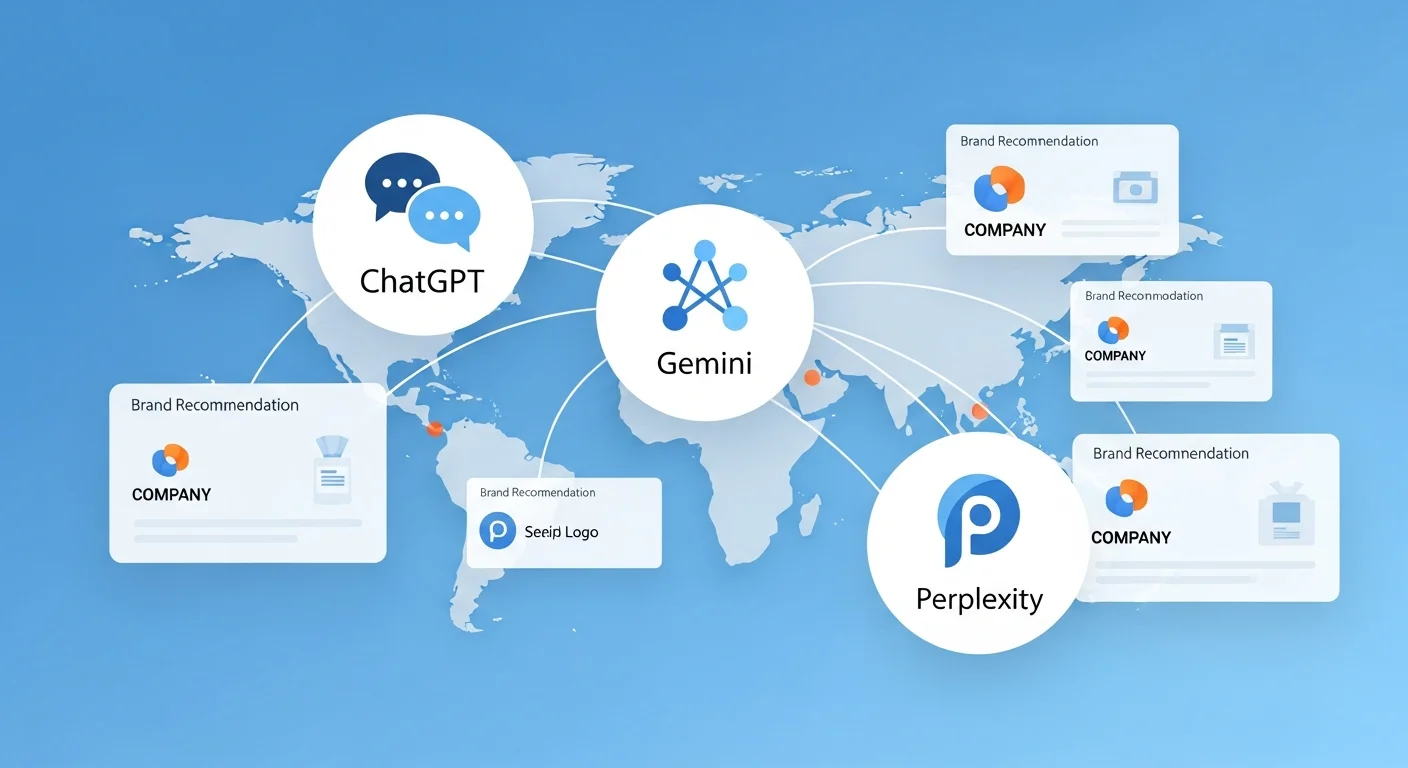
In the past, when doing SEO, the core battlefield was Google. Now brands need to pay attention to multiple AI search engines such as ChatGPT, Google AI Overview, Perplexity, Gemini, Copilot, etc. at the same time.
Each engine's content preferences and citation logic are not exactly the same. For example, Perplexity prefers to cite content with clear source links, while ChatGPT may value the accumulation of brand authority in training data.
That's not to say you need to optimize individually for each AI search engine – that's not realistic. Rather, the bottom layer of your content needs to have the common quality standard of "being cited by any AI". This is exactly The core differences between GEO and traditional SEOlocation.
Analysis of the extent to which different industries are affected by AI search
AI search has an impact on all industries, but the depth and urgency of the impact vary widely.
B2B/SaaS: Deepest impact, shortest window
B2B decision-makers are heavy users of AI search. When CTOs or procurement leaders evaluate a SaaS tool, they increasingly ask ChatGPT or Perplexity first: "Which one is better for cross-border e-commerce ERP?" If your brand is not included in the AI's answer, you do not exist in the decision-maker's awareness.
B2B companies have a long customer acquisition cycle. If they are excluded from the earliest stage of "information collection", all subsequent marketing investments will be wasted.
suggestion: B2B and SaaS companies should be the first to deploy AI search optimization, and the window period may only be 12-18 months.
Cross-border e-commerce/DTC: medium impact, but fastest growing
E-commerce brands are currently not as affected by the direct traffic of AI searches as B2B, because shopping searches are still dominated by Google Shopping and Amazon. But the trend is changing - more and more users are starting to use AI to do pre-purchase research: "What are the best wireless headphones in 2026?" "Which brand or brand is more cost-effective?"
The influence of AI in the "pre-purchase research" stage is growing rapidly. Brands that can be recommended by AI at this stage will gain a huge advantage when users make final purchases.
Content/Knowledge Industry: The most direct and urgent impact
If your business model relies on content traffic - such as online education, knowledge payment, and media publishing - the impact of AI search on you will be survival-level. AI can directly summarize your content to users, and users do not need to visit your website to obtain the information.
That's not entirely a bad thing – if the AI cites your brand and links to it, you're likely to get more targeted, higher-quality traffic. The key is whether your content is recognized by AI as an "authoritative source worthy of citation."
What companies should do now: From passive waiting to proactive deployment
After understanding the trend, the key question is: How should companies respond?
Step One: Diagnose Current AI Search Visibility
Most businesses don't even know how they're performing in AI search. Do a simple thing first: open ChatGPT, Perplexity, and Google AI Overview, enter your industry's core questions, and see if your brand is mentioned in the AI's answers.
If the answer is "no" - congratulations, at least you know what the problem is.
Step Two: Build "AI Quotable" Content Assets
Traditional SEO content may need to adjust its strategy. The point is not to write more content, but to make existing and new content more citable:
- Provide clear, data-backed answers to core industry questions
- Build brand knowledge anchors - let AI recognize your brand authority during training and retrieval
- Boost external citations and brand mentions (these are important signals for AI assessment of authority)
- Publish original research and data reports (AI prefers to cite primary data sources)
On why brands must start taking this seriously,Getting Started with GEO Generative Engine OptimizationThis article has a more complete analysis.
Step 3: SEO + GEO dual tracks in parallel, rather than choosing one or the other
A common misunderstanding is: With the advent of AI search, SEO is no longer necessary.
The real situation is: Google search will not disappear in the short term, but the traffic proportion of AI search is growing rapidly. The underlying logic of the two is different - SEO optimization ranking, GEO optimization citation. But there is a synergistic effect between the two: the authority of content accumulated by SEO will enhance the citation rate of GEO, and the brand mentions brought by GEO will feed back the external links and brand signals of SEO.
The smartest way is to run both tracks in parallel. If you're already doing SEO, the marginal cost of adding GEO isn't high, but the benefits can be exponential.

SeaSeek's point of view: AI search is not a threat, but an opportunity to redefine the rules
As a pioneer in the GEO field, we have a core judgment on the impact of AI search in the process of serving 500+ global expansion companies at SeaSeek:AI search is not taking away your traffic, but redefining "who deserves to be recommended."
In the past, SEO competition was largely about "who knows the skills better" - the number of external links, keyword density, and technical optimization. In the era of AI search, competition has returned to the most essential issue: whether your brand is really authoritative and valuable in the industry.
Our experience is that businesses that focus on content quality, brand building, and E-E-A-T in traditional SEO generally perform better in AI search. And those brands that rely on tricks and shortcuts have almost no presence in AI search.
Based on 7 self-developed software works (including AI keyword ranking optimization system, generative AI content management platform, NLP corpus intelligent analysis system, etc.), SeaSeek has built a complete GEO methodology from AI search visibility audit to Share of Model optimization. We believe that the sooner companies deploy GEO, the more opportunities they have to take the lead in the AI search era.
Summary: Five key takeaways from AI search trends in 2026
-
The proportion of AI search traffic is growing rapidly: The three major engines of ChatGPT search, Google AI Overview, and Perplexity are expanding at the same time. Enterprises cannot only focus on Google rankings.
-
User behavior has changed: From "entering keywords" to "asking questions", AI becomes the middle layer for information screening, and brands need to be recognized and quoted by AI.
-
Content standards are upgrading: Pure SEO optimized content is no longer enough, it needs to have high information density, data support, authoritative signals and structured expression.
-
B2B and SaaS industries most affected: Decision makers are the first to migrate their information acquisition methods to AI search, with a limited window period.
-
SEO + GEO dual-track strategy is the optimal solution: It's not about choosing one or the other, but amplifying each other. Start laying out GEO now, with low marginal costs and high long-term returns.

Want to learn more about what generative search means for your brand? We have compiled a complete GEO white paper, covering the methodology, indicator system and practical steps of AI search optimization.Download the GEO white paper, get your starting point for AI search optimization.
For more in-depth articles about GEO, you can browse GEO Insight Column.